

In the world of professional security, information moves fast, and so do threats. Whether you’re overseeing a sprawling fulfillment center, coordinating response across a hospital campus, or managing access at a university with tens of thousands of students, the quality of your communications infrastructure can be the difference between an incident contained and a crisis compounded.
Yet despite significant investment in cameras, access control systems, and monitoring platforms, many security operations still rely on fragmented, aging radio communications setups, ones that weren’t designed for the complexity of modern environments. Radio dispatch consoles represent one of the most important, and often underappreciated, upgrades a security organization can make.
This post takes a closer look at what dispatch consoles actually do, how they work within real-world security contexts, and what to look for when evaluating solutions for your organization.
What Is a Radio Dispatch Console?
At its core, a radio dispatch console is a centralized communications hub that allows a dispatcher, typically stationed in a Security Operations Center (GSOC) or command post, to manage radio communications across multiple channels, talkgroups, and user groups from a single interface.
Think of it as air traffic control for your radio network. Rather than manually switching between channels on a handheld radio, a dispatcher can monitor and communicate across dozens of frequencies simultaneously, patch together teams that operate on different channels, and maintain a clear audio record of all activity.
Modern dispatch consoles have evolved well beyond physical hardware units. Today’s leading solutions are software-defined, cloud-ready platforms that can integrate with existing radio infrastructure, including legacy analog systems, digital P25, TRBO and DMR networks, without requiring organizations to scrap their current investments.
The Security Environments Where Dispatch Consoles Matter Most
Large-Scale Retail and E-Commerce Operations
Amazon-scale fulfillment centers, distribution hubs, and last-mile logistics facilities present unique security challenges: enormous physical footprints, thousands of employees across multiple shifts, and the constant movement of high-value inventory.
In these environments, a security team might simultaneously need to coordinate loss prevention personnel on the floor, communicate with dock security, liaise with local law enforcement during an incident, and maintain situational awareness across multiple camera feeds, all at once. A dispatch console gives security operations the ability to do exactly that, without the chaos of multiple radios, missed transmissions, or dead zones in communication.
Global Security Operations Centers (GSOCs)
For enterprise organizations with a GSOC model, common in banking, finance, technology, and large-scale manufacturing, dispatch capability is fundamental to the mission. GSOCs are designed to provide centralized visibility and coordination across single or geographically distributed sites. That means a single security operations team might be responsible for monitoring and responding to incidents at facilities in multiple states or countries.
Radio dispatch consoles built for GSOC environments allow supervisors to bridge communications between sites, manage radio resources remotely, and ensure that field teams on different systems can still talk to each other when a critical incident demands coordinated response.
Healthcare Security
Hospital campuses are among the most complex security environments in existence. A major medical center may have thousands of staff members, patients, and visitors across multiple buildings, all while managing everything from psychiatric holds and infant abduction protocols to active threat responses and workplace violence incidents.
Healthcare security teams rely on fast, clear communication to execute code procedures effectively. Dispatch consoles allow security command staff to instantly address the right teams through Intercoms, radios, pagers or SMS, coordinate with nursing staff on specific units, and interface directly with local EMS and law enforcement, all from a single workstation. In a code situation where seconds matter, that capability is not a luxury. It’s a necessity.
Education and Campus Security
University and K-12 campus environments span large geographic areas with diverse populations, open access points, and limited security staffing. Campus security teams are routinely expected to manage everything from routine noise complaints to mental health crises to active threat situations, often simultaneously.
A dispatch console enables campus security leadership to manage radio communications across multiple zones or buildings, coordinate with local police and emergency services, and maintain a clear operational picture during large-scale events like graduation ceremonies, athletic events, or campus emergencies.
Key Capabilities That Make the Difference
Not all dispatch consoles are created equal. Here are the functional capabilities that distinguish enterprise-grade solutions from basic radio management tools:
Multi-Channel Monitoring The ability to simultaneously monitor activity across multiple radio channels, talkgroups, or sites is foundational. Dispatchers should be able to see and hear activity across their entire radio network without switching back and forth manually.
Cross-System Patching Organizations rarely operate on a single, unified radio system. A hospital’s security team might run on a different network than the local fire department. A corporate campus might have legacy analog radios alongside a newer digital system. Patch functionality allows a dispatcher to bridge communications across these otherwise incompatible systems, enabling real-time coordination during incidents.
Priority and Emergency Alerting When a user activates an emergency button on their radio, the dispatch console should immediately surface that alert, visually and audibly, with precise identification of who triggered the alarm, on which channel, and ideally with location context. This ensures no emergency call goes unnoticed, even during high-volume communication periods.
Audio Logging and Recording A complete, searchable record of all radio communications is invaluable for post-incident review, liability documentation, and after-action training. Enterprise dispatch consoles typically integrate with logging systems that timestamp and archive every transmission.
Interoperability Modern security operations don’t operate in a silo. The best dispatch solutions integrate with CAD (Computer-Aided Dispatch) systems, video management platforms, and access control systems, allowing security personnel to manage incidents across multiple tools without toggling between disconnected platforms.
Remote and Distributed Operation As organizations increasingly adopt hybrid staffing models and remote operations centers, the ability for dispatchers to operate from virtually any location, with the same capabilities they’d have at a physical console, has become a critical feature. Imagine covering a shift for a sick colleague in a different location or country; that is the reality now.
Cloud-Ready Dispatch: Why It Changes the Conversation
Traditional dispatch consoles required significant on-premises infrastructure, dedicated servers, hardware consoles, and physical connections to radio systems. While these setups remain common, they introduce limitations: scalability constraints, high maintenance overhead, limited remote access, and significant capital expense.
Cloud-ready dispatch platforms address each of these challenges. By leveraging cloud infrastructure, organizations can deploy dispatch capability without the same level of physical infrastructure, scale operations more flexibly as their needs change, and extend console access to remote operators without complex networking setups.
Enlite Cloud Ready Dispatch: Built for the Modern Security Environment
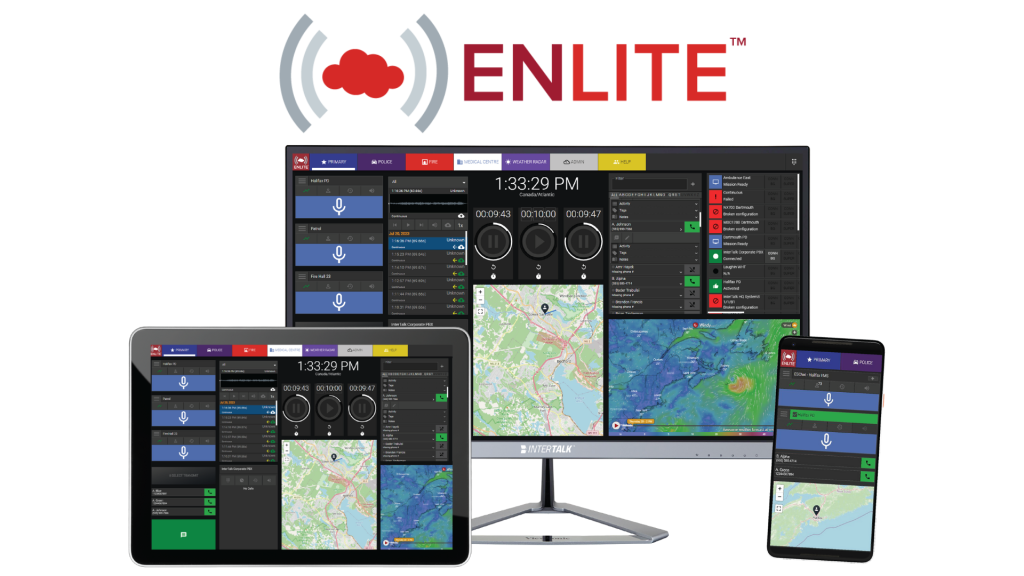
InterTalk’s Enlite Cloud Ready Dispatch was designed with exactly these operational realities in mind. Enlite is a software-based, cloud-ready dispatch platform that connects to your existing radio infrastructure, whether that’s a legacy analog network, a digital P25 system, or anything in between, and delivers enterprise-grade dispatch capability through an intuitive, web-based interface.
Here’s what sets Enlite apart in security-focused deployments:
True Cloud Flexibility Enlite operates via standard internet connectivity, meaning dispatchers can work from a GSOC, a remote office, or even a home workstation without losing any capability. For organizations managing multiple sites or needing redundant dispatch locations, this flexibility is transformative.
Multi-System Interoperability Enlite supports a wide range of radio protocols and infrastructure types, including connection through existing IP-based radio networks. Security teams don’t have to replace their radio investments to gain dispatch-level control over their communications.
Scalable Architecture Whether you’re a single-site security department with a handful of radio users or a multi-national organization managing hundreds of channels across dozens of locations, Enlite’s architecture scales with you. Add users, channels, or sites as your operational footprint grows.
Intuitive User Interface Dispatch operators don’t have time for a steep learning curve. Enlite’s interface is designed for clarity under pressure, making it easy to monitor channels, initiate calls, respond to emergencies, and manage patches quickly and accurately.
Integration-Ready Design Enlite is built to connect with the broader security technology ecosystem, supporting integration via REST API with logging systems and other critical infrastructure tools that security teams rely on daily.
Resilient and Redundant Cloud infrastructure isn’t just about convenience, it also provides resilience. Enlite’s cloud-ready design supports redundant configurations that help ensure dispatch capability remains available even during local infrastructure disruptions.
Building a Communications Strategy That Matches Your Risk Profile
For security professionals evaluating their communications infrastructure, the starting point should always be a clear understanding of your operational environment: How many radio users do you manage? How many physical sites? What radio systems are in place today? What are your peak-demand scenarios?
From there, a dispatch console evaluation should focus on interoperability (can it work with what you already have?), scalability (can it grow with you?), usability (will operators be effective under pressure?), and resilience (what happens if connectivity is disrupted?).
The goal isn’t just to modernize for its own sake. It’s to ensure that your communications infrastructure can support effective command and control during the moments that matter most, when an incident is unfolding, when seconds count, and when clear communication is what separates a controlled response from a chaotic one.
Learn More About Enlite
If you’re evaluating dispatch solutions for your security operation, whether you’re a healthcare system, a corporate campus, a logistics network, or a public safety-adjacent organization, Enlite Cloud Ready Dispatch is worth a close look. Our team is available to walk you through the platform, discuss your specific operational environment, and help you understand how Enlite fits into your existing infrastructure.
FAQ
1. What is a radio dispatch console, and how does it differ from a standard two-way radio?
A standard two-way radio lets one person communicate on a single channel at a time. A radio dispatch console is a centralized platform that allows a trained dispatcher to monitor and manage communications across multiple channels, talkgroups, and radio systems simultaneously, all from one interface. It’s designed for command-and-control environments where situational awareness across an entire operation is critical, rather than point-to-point communication between individuals.
2. Do we need to replace our existing radio infrastructure to use a dispatch console?
Not necessarily. Modern dispatch consoles like Enlite Cloud Ready Dispatch are built to integrate with a wide range of existing radio infrastructure, including legacy analog systems and digital networks like P25 and NXDN. The goal is to layer dispatch capability on top of what you already have, protecting your current investment while significantly expanding your team’s communications control.
3. Is a cloud-ready dispatch console secure enough for sensitive security environments?
Yes, when properly configured, cloud-ready dispatch platforms meet the security and reliability standards required for professional security operations. Cloud architecture actually adds resilience benefits, such as redundant configurations that keep dispatch operational even during local infrastructure disruptions. Organizations in regulated industries like healthcare should confirm that any solution they evaluate aligns with their specific compliance requirements.
Recent News
Enlite Feature Update | Q2 2026
It's been a big quarter for Enlite. From April through June 2026, our development team shipped a wave of new capabilities focused on smarter call management, the foundation for AI-powered transcription, and meaningful improvements to console reliability and dispatcher...
Beyond Words: Why Plain Text Is Not the Whole Story in Public Safety
It is 2:47 in the morning. A call comes in. A voice says three words: "Please send help." Then the line goes quiet. The Dispatcher's Ear An experienced dispatcher does not hear only the words. They hear the breathing. They notice the hesitation. They recognize that...
Enlite Feature Update | Q1 2026
From January through March 2026, the Enlite team delivered a series of updates focused on dispatcher efficiency, radio operations flexibility, and improved audio/messaging workflows. Below is a summary of the key new features now available in Enlite. New Feature...


