

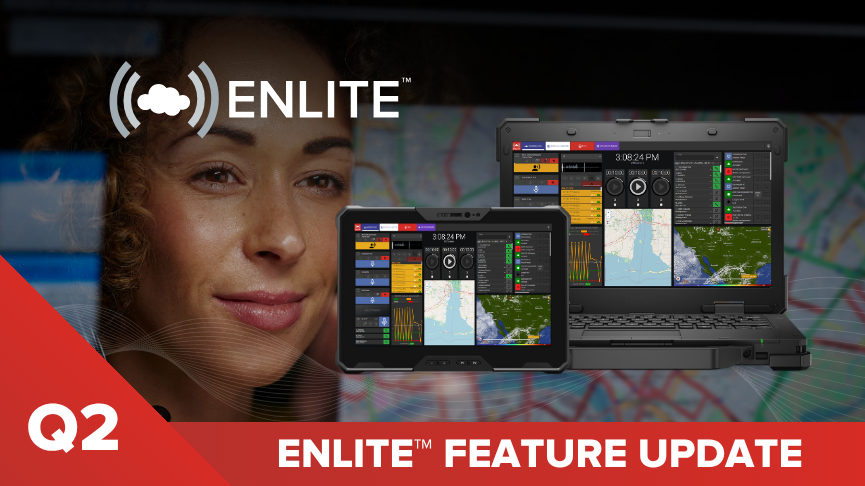
It’s been a big quarter for Enlite. From April through June 2026, our development team shipped a wave of new capabilities focused on smarter call management, the foundation for AI-powered transcription, and meaningful improvements to console reliability and dispatcher experience. Here’s what’s new.
Call Ring Groups: Smarter Call Routing for Multi-Position Centers
The headline feature of Q2 is Call Ring Groups, a configurable call priority and routing system designed for multi-position call centers.
Configurable priority levels
Administrators can now define call priority labels (e.g., Normal, Urgent, E911, Mayday) with custom colors, then assign them to specific phone queues. Incoming calls are automatically tagged and sorted by priority, ensuring the most critical calls rise to the top.
Ring group visibility rules
Dispatchers only see the ring groups relevant to their mission. Administrators control which groups appear for each queue, keeping the interface clean and focused.
Real-time group monitoring
Before transferring a call, dispatchers can see at a glance how many users are online in each ring group, preventing transfers to unattended groups.
Automatic Call Distribution Using Macros
A new macro action lets centers automatically assign incoming calls to a specific ring group based on caller ID patterns. For example, all calls from a New York area code can be routed directly to the New York Dispatchers group.
Enforced single call answer
Only one dispatcher can answer an inbound call at a time. Others can join afterward using barge-in, keeping call ownership and controls predictable.
Telephony Enhancements
Per-mission phone control
Dispatchers can now choose which phone queues ring on each mission, treating phones like any other communications widget. If a mission doesn’t have a phone widget, it won’t ring — giving operators full control over their workspace.
Call wait times
The call queue now displays how long each call has been waiting, giving dispatchers immediate visibility into queue health; a critical feature for call-centre-style operations.
Phone queue connection status
Dispatchers can now see at a glance whether their phone queue is actively registered and ready for calls, with clear visual indicators for connected, connecting, and disconnected states.
Custom ringers per phone queue
Different phone queues can now have distinct ringtones, making it easy for dispatchers to identify which line is ringing without looking at the screen.
Emergency & Safety
Cross-console emergency alarm synchronization
When an emergency alarm is cleared on one console, it now clears across all consoles automatically, eliminating the need for each position to independently acknowledge the same alarm.
Headset sharing audio recorded to IRR
For agencies using NENA-compliant headset sharing (e.g., to answer external 911 calls), the headset input and output audio is now captured in Enlite’s IRR recordings for review, playback, and operational recordkeeping.
Connection & Reliability
Channel connection priority
Administrators can now assign connection priority to each channel, controlling which radios and phones connect first during startup. High-priority channels connect immediately while lower-priority channels wait, reducing startup times.
AI-Powered Transcription (Foundation)
Q2 lays the groundwork for AI-powered audio transcription within Enlite. The system can now extract and package IRR (Instant Recall Recorder) audio, submit it to InterTalk’s Polyspeak transcription model, and process results asynchronously through a dedicated background worker keeping the dispatch console responsive while AI processing runs behind the scenes. This is the foundation for upcoming features that will bring real-time and post-call transcription directly into the dispatcher workflow.
What’s Next
Q3 2026 development is underway, with continued focus on AI transcription integration, DMR protocol support, and further reliability improvements. Stay tuned for more updates.
FAQ
Q: What is Call Ring Groups, and why is it a big deal for multi-position call centers?
A: Call Ring Groups is a configurable call priority and routing system that automatically tags and sorts incoming calls by priority level (e.g., Normal, Urgent, E911, Mayday), using custom labels and colors defined by administrators. It also adds ring group visibility rules, real-time monitoring of who’s online in each group, and macro-based automatic call distribution by caller ID pattern, so calls reach the right dispatchers faster and with less manual triage.
Q: How does Enlite prevent confusion when multiple dispatchers could answer the same call?
A: Enlite now enforces single call answer, meaning only one dispatcher can pick up an inbound call at a time. Other dispatchers can still join an active call via barge-in, so call ownership stays clear while allowing collaboration when needed.
Q: What telephony improvements were added to give dispatchers more control over their workspace?
A: Several updates give dispatchers finer control: per-mission phone control lets them choose which phone queues ring on a given mission, call wait times show how long each call has been queued, phone queue connection status displays whether a queue is registered and ready, and custom ringers per phone queue help dispatchers identify which line is ringing without looking at the screen.
Q: What’s the status of AI-powered transcription in Enlite?
A: Q2 2026 laid the foundation. Enlite can now extract and package IRR audio, submit it to InterTalk’s Polyspeak transcription model, and process results asynchronously through a background worker so the console stays responsive during processing. This groundwork sets up upcoming features for real-time and post-call transcription directly in the dispatcher workflow, which is a continued focus for Q3 2026.


